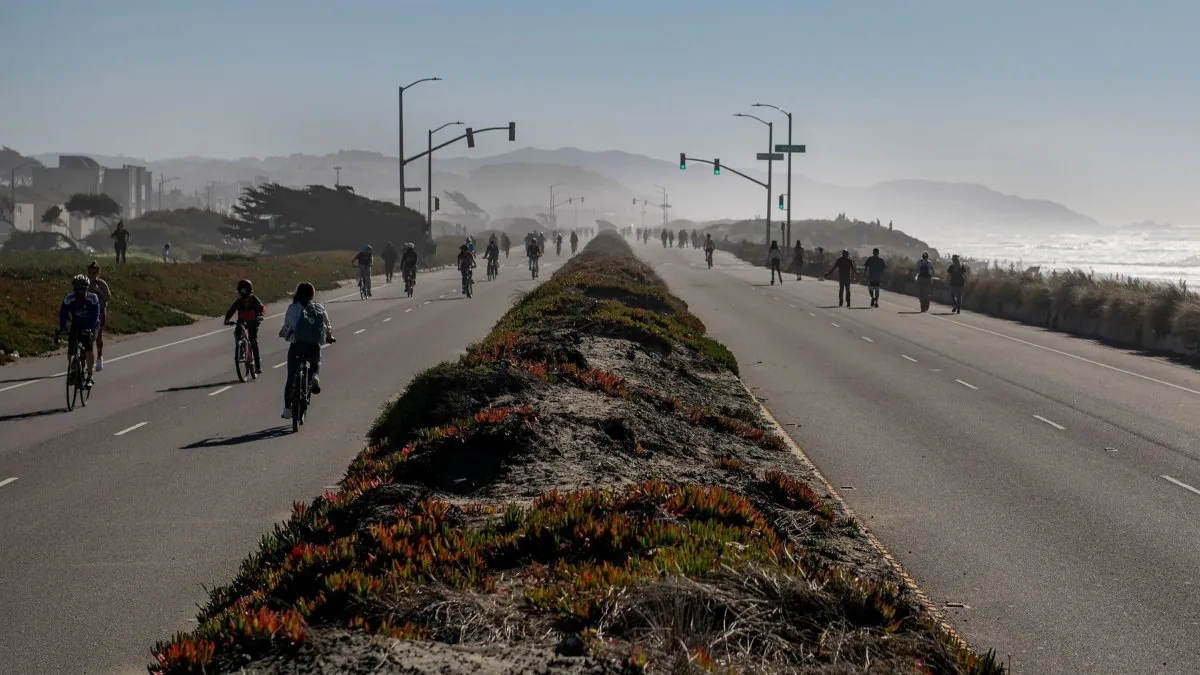
SAN FRANCISCO, CA — San Francisco voters are headed back to the ballot box on the Great Highway, where a new measure would reopen the coastal roadway to cars on weekdays while keeping it as a park on weekends.
The proposal, known as Prop G, is being framed by supporters as a compromise after the city’s earlier decision to close the Upper Great Highway to cars full time. Opponents say the park created on the roadway should stay in place and warn that the election could undo a hard-won public space along Ocean Beach.
The measure comes after a yearslong fight over how the 2-mile stretch should be used, and it is set to be one of the city’s closely watched November contests.
How Prop G would change the Upper Great Highway
Prop G would restore weekday vehicle access on the Upper Great Highway from Monday through Friday. On Saturdays and Sundays, the road would remain a park.
Supporters say that arrangement mirrors the setup used during the COVID-19 pandemic, when traffic was lighter and more people were looking for outdoor space. They argue the road can serve both commuters and recreation if it is shared by time of week.
The route was fully shut to cars under Proposition K, which passed in November 2024. That earlier measure turned the roadway into a coastal park now called Sunset Dunes.
City records and officials say the closure took effect on March 14, 2025, after which streetlights at intersections were removed and park features began replacing roadway elements.
Supporters say weekday access matters for commuters and safety
Supervisor Alan Wong, who represents District 4, is among the measure’s most visible supporters. He said weekday driving access should take priority over recreational use for people trying to get to work or school.
Wong said it is fair to share the roadway during the workweek because commuter demand is highest then. District 4 includes the Sunset district, where the Upper Great Highway sits.
Backers of Prop G also argue that traffic injuries in the Sunset have increased since the road closed, because drivers are being pushed onto nearby streets. Richard Corriea, who leads the Yes on G campaign, made that case in the official proponent statement submitted to the Department of Elections.
They say reopening the road on weekdays would ease pressure on surrounding streets while still leaving the coast available for park use on the weekend.
Crash data and transit studies complicate the debate
Opponents say the safety argument does not match the numbers. Data from the San Francisco Police Department and the Department of Public Health show 106 traffic collisions resulting in injury in District 4 in 2024, compared with 99 in 2025.
Friends of Sunset Dunes and other pedestrian safety advocates have pointed to those figures as evidence that crashes have not risen since the closure. Lucas Lux, the group’s president, said the campaign for Prop G is misleading voters about traffic outcomes in the neighborhood.
A separate study by the San Francisco Municipal Transportation Agency found that some nearby streets did see more congestion after the closure, including the Lower Great Highway and Chain of Lakes Drive. Muni buses also saw minor increases in travel times on 19th Avenue.
Those findings suggest the closure changed traffic patterns, but they do not settle the larger fight over whether the road should stay a park or return to weekday car traffic.
Park supporters say Sunset Dunes is already drawing families
Opponents of Prop G, including Friends of Sunset Dunes, argue that the measure would dismantle a park that is still taking shape. Lux said the area is evolving and that residents asked for places where children could play and spend time outdoors.
He said the new playground that opened over the weekend is part of that vision. If Prop G passes, he argued, the playground and other park features would have to be removed.
Supervisor Myrna Melgar, who opposes the measure, also pointed to the number of children using the new pirate-themed playground. She said the park gives young families a place that they will be able to grow up with over time.
San Francisco Recreation and Park Department data show the park averages 3,800 visitors on weekdays and 7,200 on weekend days, suggesting steady use even as the debate continues.
City officials warn of millions in costs if cars return
The City Controller’s Office says making the road car-ready again would raise government costs significantly. Deputy Controller ChiaYu Ma wrote to the Department of Elections that the change would require new traffic signals, restriping, signage and the removal of park amenities.
The office estimates those changes could cost about $10 million. It also says annual sand removal could add anywhere from $100,000 to $1.5 million in yearly expenses.
At the same time, the city could save about $300,000 a year because it would not need to staff the park full time, according to the controller’s estimates. Supporters of Prop G have not disputed that the measure would carry costs, but they argue commuter access and neighborhood traffic concerns justify the change.
With those competing claims in play, the fiscal impact has become one more part of the argument voters will weigh in November.
Ballots and voter packets are already on the way
San Franciscans should start receiving official ballot packets in early October. The packets will include the sample ballot, local candidate information, ballot measures, ranked-choice voting instructions and guidance for voting by mail or in person.
Voter pamphlets have already started arriving in mailboxes. Residents can also check their registration status through the city’s elections website.
For now, the Great Highway fight remains one of the city’s clearest examples of a post-pandemic land-use dispute: one side wants the road back for weekday driving, while the other sees Sunset Dunes as a new civic space that should stay in place.
What voters decide in November will determine whether that compromise survives or whether the former roadway returns to cars during the workweek.